As we've discussed before, there is a "unified credit" against the gift and estate taxes which cancels out the tax on some wealth transfers--we often call the amount protected from tax the "exemption equivalent." Right now, that exemption equivalent is $5 million (plus an annual inflation adjustment), though it is scheduled to be reduced to $1 million (plus an inflation adjustment) with the expiration of the 2001 and 2010 tax acts at the end of this year. (The Obama administration has proposed making the future exemption equivalent $3.5 million in its last budget, but for various political reasons this is unlikely to be enacted before the election.)
If you want to make large transfers of wealth and not pay taxes (who doesn't?), you have to make sure not to give away more than the exemption equivalent. With cash or easily-valued assets such as marketable securities, this is not difficult to accomplish. For farmers and other family business owners, the bulk of their wealth is in non-liquid assets like land and closely-held business assets which, if you're not selling them to a buyer at arm's length, must be valued by an appraisal. An appraisal is a professional opinion as to the "fair market value"--"the price that would be agreed on between a willing buyer and a willing seller, with neither being required to act, and both having reasonable knowledge of the relevant facts" as the IRS defines it. It is not unusual for two appraisers to come to different valuations for the same asset in perfect good faith.
If the taxpayer wants to give the full amount of the exemption equivalent, and the assets available to make the gift are the sort that have to be valued by appraisal, a lot is riding on that appraisal. Human nature being what it is, the government's expert appraiser usually values
gifts or estate assets higher than the taxpayer's expert appraiser,
particularly when the government's valuation results in a taxable transfer in excess of the available exemption equivalent and a tax due! This naturally leads to a lot of IRS audits, administrative appeals, and Tax Court litigation.
One tactic used by taxpayers who wanted to max out their tax-free gifting was to make a combined gift of property to individuals and charities. The gift instrument would designate that a fixed amount was to go to the individuals and the excess to charity. This discouraged the government from attacking the taxpayer's valuation because any increase in the value of the gift would pass to a charity--and the IRS still wouldn't collect any tax on it.
In a recent Tax Court case reported on in the Wall Street Journal, the taxpayers made a gift of closely-held business interests under an instrument which limited the gift to $1 million, with no charitable excess gift. The IRS revalued the assets at something more than $1 million. The Tax Court ruled that the excess over $1 million was not a gift because the taxpayers expressed an unambiguous intent to give $1 million and no more.
This obviously makes it easier for taxpayers to make controlled tax-free gifts of hard-to-value assets, particularly high net-worth individuals who want to make large lifetime gifts before the exemption equivalent goes down at the end of this year. As the Journal observes, "The decision is so advantageous for taxpayers that it could inspire a response from Congress or the IRS."
Showing posts with label federal estate tax. Show all posts
Showing posts with label federal estate tax. Show all posts
Monday, April 30, 2012


Friday, September 30, 2011
Federal Estate and Gift Taxes -- Generation Skipping Taxes and How They Affect Trust Design
In the previous post, we took a quick overview of the generation-skipping transfers tax, "affectionately" known as the "GST." This is the tax that's imposed, in addition to the federal estate or gift tax, on any "generation-skipping transfer." A "generation-skipping transfer" (sometimes called a "skip") is any transfer, at death or by gift, to a "skip person." To illustrate what a "skip person" is, let's use the family tree from the last post, with a slight modification:
Grandma
|
|
Junior
|
|
Skippy
|
|
Skippy II
Grandma is the person who's going to be making the transfer. Assuming all of these people are living on the date of the transfer, Skippy and Skippy II would be "skip persons" and Junior would be a "non-skip person"--yes, that's the official term from the tax code. A gift to Skippy or Skippy II would be a "generation-skipping transfer," and will be subject to the GST unless the annual exclusion applies or Grandma has GST exemption she can allocate to the transfer. A transfer to Junior is not a skip, and will not be subject to the GST. (If Junior dies, and then Grandma makes a transfer to Skippy, that will not be a skip because there is no living person in the generation between them, and the GST won't apply--but transfers to Skippy II will still be skips subject to GST.)
So far, I've been talking about outright gifts. If the gifts are made to a trust, the question of whether they're skips or not is determined by looking at the beneficiaries of the trust. A gift to a trust for the benefit of Skippy will be a skip because Skippy is a skip person. A trust for the benefit of Skippy and Skippy II--same result, because all of the beneficiaries are skip persons. All of these transfers are called "direct skips," and if there's any GST to be paid, it's paid when the transfer is made.
Now for the tricky part: what about a trust for the benefit of Junior, Skippy, and Skippy II? Let's assume for purposes of the example that the trustee can make distributions to any one or more of these three people in its discretion. A trust like this might be seen where Junior is the "gray sheep" of the family.
In this case, when Grandma puts assets into the trust, we don't know if the transfer is a skip yet because we don't know if any particular property in the trust will be distributed out to a skip person (Skippy and Skippy II) or a non-skip person (Junior). If the trust makes any distribution to Junior, those are not skips, and there's no GST. Any distributions to Skippy or Skippy II are "taxable distributions" on which a GST will have to be paid at the time of distribution unless Grandma allocated GST exemption to the trust back when she created it.
What happens when Junior dies? As of that moment, we know for a certainty that all future distributions will be to the skip persons. Junior's death is therefore a "taxable termination"--it's called that because the interests of all non-skip persons in the trust have terminated--and is the occasion for assessing the GST against all of the remaining trust property--again, unless Grandma allocated GST exemption to the trust back when she created it.
In other words, a transfer to one of your children which is held in trust for life, with final distribution to your grandchildren, may subject the trust property to the GST. Therefore, it's necessary to allocate GST exemption to the trust when the trust is created; this is done on the relevant estate tax or gift tax return. If you don't have enough GST exemption to cover the entire transfer, the trust has to be designed so that the non-exempt part is included in your child's estate so that it's taxed there instead of being hammered by the GST.
Monday, September 26, 2011
Federal Estate and Gift Taxes -- the Generation Skipping Transfers Tax
The generation-skipping transfers tax, or "GST" for short, is perhaps the hardest-hitting element of the federal wealth transfer tax system. For purposes of illustration, let's use a very simple family tree:
To begin, imagine that it's before 1976, when the first version of the GST was enacted. (It was replaced in 1986 with the arrangement we have today.) By virtue of his place in the family business and/or earlier gifts from Grandma, Junior is independently wealthy. Anything that Grandma leaves to him at death will simply get added to Junior's gross estate and taxed again at Junior's passing. What people in Grandma's position often did was to create a trust for Skippy and the other grandkids, and perhaps also later generations, and thus "skip" taxation in Junior's generation. The trust usually could reach no farther than the grandchildren's generation because of something called the Rule Against Perpetuities, which we'll discuss another time.
As we've noted in earlier posts, one of the baseline policies of the gift and estate tax system is to tax accumulated wealth once per generation, and generation skipping transfers like these cut that down to once every other generation. Because most people would only do this if Junior was well provided-for, these "generation-skipping trusts" were a strategy only a very very high net worth family could make use of--so that the estate and gift taxes actually fell harder on those who were wealthy enough to pay estate taxes, but not wealthy enough to play at generation skipping.
To redress this flaw and discourage generation skipping transfers, Congress enacted the GST. The GST is imposed, in addition to the estate or gift tax, on any transfer to a "skip person." There's a complex definition of a "skip person" in the tax code, but what it boils down to is that, in the example above, Skippy is a "skip person" if Junior is living on the date of the transfer. If Junior dies, and then Grandma makes the transfer to Skippy, it's not a generation skipping transfer and the GST does not apply.
What makes the GST hit so hard is the rate of tax: it's equal to the highest estate tax rate then in effect. In 1986, when the modern version of the GST entered the tax code, that top rate was 55%--so it was possible for a generation-skipping transfer to be taxed at a combined 110% (up to 55% estate/gift tax + 55% GST). The purpose of this was not to collect a 110% tax so much as it was to make large generation-skipping transfers so uneconomical that no one would want to do them.
Well, maybe not all generation-skipping transfers. Not wanting tax policy to interfere too much with the time-honored tradition of doting on grandchildren, Congress also provided that the GST does not apply to most annual exclusion gifts, and gave every person a $1 million GST exemption. The exemption let each person transfer a total of $1 million to the grandkids (and other skip persons) before the GST kicked in. (There was also a $2 million-per-grandchild temporary exemption which expired in 1989--named the "Gallo provision" in honor of the high net-worth family which "suggested" it to their Congressional representatives.)
Under the 2001 tax act ("the Bush tax cuts"), the GST exemption increased in parallel with the exemption equivalent provided by the estate and gift tax unified credit, so that it reached $3.5 million in 2009. During the "estate tax holiday" in 2010, there was (so we thought) no GST at all. The 2010 tax act reinstated the GST retroactive to January 1, 2010, but at a 0% rate--so if you made a generation-skipping transfer before the tax was retroactively re-imposed, you didn't get hit with a surprise tax assessment. For 2011 and 2012, the GST exemption is $5 million. Unless Congress acts before the end of next year, the GST exemption will "snap back" to $1 million on January 1, 2013, as part of what the media calls the "expiration" of the "Bush tax cuts."
You may think that the GST is a problem only for the super wealthy, but it can affect people of relatively modest means. A trust for your "gray sheep" child which holds the assets for the child's life, then distributes to that child's offspring afterward, is a generation-skipping transfer that is subject to the tax unless there is sufficient GST exemption to cover it. We'll talk about how the GST affects trust design, and some of the "work-arounds" that have been developed to counter it, in future postings.
Grandma
|
|
Junior
|
|
Skippy
To begin, imagine that it's before 1976, when the first version of the GST was enacted. (It was replaced in 1986 with the arrangement we have today.) By virtue of his place in the family business and/or earlier gifts from Grandma, Junior is independently wealthy. Anything that Grandma leaves to him at death will simply get added to Junior's gross estate and taxed again at Junior's passing. What people in Grandma's position often did was to create a trust for Skippy and the other grandkids, and perhaps also later generations, and thus "skip" taxation in Junior's generation. The trust usually could reach no farther than the grandchildren's generation because of something called the Rule Against Perpetuities, which we'll discuss another time.
As we've noted in earlier posts, one of the baseline policies of the gift and estate tax system is to tax accumulated wealth once per generation, and generation skipping transfers like these cut that down to once every other generation. Because most people would only do this if Junior was well provided-for, these "generation-skipping trusts" were a strategy only a very very high net worth family could make use of--so that the estate and gift taxes actually fell harder on those who were wealthy enough to pay estate taxes, but not wealthy enough to play at generation skipping.
To redress this flaw and discourage generation skipping transfers, Congress enacted the GST. The GST is imposed, in addition to the estate or gift tax, on any transfer to a "skip person." There's a complex definition of a "skip person" in the tax code, but what it boils down to is that, in the example above, Skippy is a "skip person" if Junior is living on the date of the transfer. If Junior dies, and then Grandma makes the transfer to Skippy, it's not a generation skipping transfer and the GST does not apply.
What makes the GST hit so hard is the rate of tax: it's equal to the highest estate tax rate then in effect. In 1986, when the modern version of the GST entered the tax code, that top rate was 55%--so it was possible for a generation-skipping transfer to be taxed at a combined 110% (up to 55% estate/gift tax + 55% GST). The purpose of this was not to collect a 110% tax so much as it was to make large generation-skipping transfers so uneconomical that no one would want to do them.
Well, maybe not all generation-skipping transfers. Not wanting tax policy to interfere too much with the time-honored tradition of doting on grandchildren, Congress also provided that the GST does not apply to most annual exclusion gifts, and gave every person a $1 million GST exemption. The exemption let each person transfer a total of $1 million to the grandkids (and other skip persons) before the GST kicked in. (There was also a $2 million-per-grandchild temporary exemption which expired in 1989--named the "Gallo provision" in honor of the high net-worth family which "suggested" it to their Congressional representatives.)
Under the 2001 tax act ("the Bush tax cuts"), the GST exemption increased in parallel with the exemption equivalent provided by the estate and gift tax unified credit, so that it reached $3.5 million in 2009. During the "estate tax holiday" in 2010, there was (so we thought) no GST at all. The 2010 tax act reinstated the GST retroactive to January 1, 2010, but at a 0% rate--so if you made a generation-skipping transfer before the tax was retroactively re-imposed, you didn't get hit with a surprise tax assessment. For 2011 and 2012, the GST exemption is $5 million. Unless Congress acts before the end of next year, the GST exemption will "snap back" to $1 million on January 1, 2013, as part of what the media calls the "expiration" of the "Bush tax cuts."
You may think that the GST is a problem only for the super wealthy, but it can affect people of relatively modest means. A trust for your "gray sheep" child which holds the assets for the child's life, then distributes to that child's offspring afterward, is a generation-skipping transfer that is subject to the tax unless there is sufficient GST exemption to cover it. We'll talk about how the GST affects trust design, and some of the "work-arounds" that have been developed to counter it, in future postings.
Thursday, September 15, 2011
The Classic A-B Trust Estate Plan
In previous articles, I've discussed the basics of the federal estate tax, including the unified credit and the unlimited marital deduction. In this installment, I'm going to explain how a married couple can use the marital deduction and the unified credit in the most efficient manner. Under the estate tax as it presently stands, a couple can transmit up to $10 million to the next generation without paying any federal estate tax, and deferring any estate tax at all to the second death. This is accomplished by the use of an estate planning tactic known as an "A-B Trust."
The A-B Trust works like this: the couple divides their assets equally, and each of them creates a revocable trust to hold their share of the assets. When one of them dies, the deceased person's trust splits into two components:
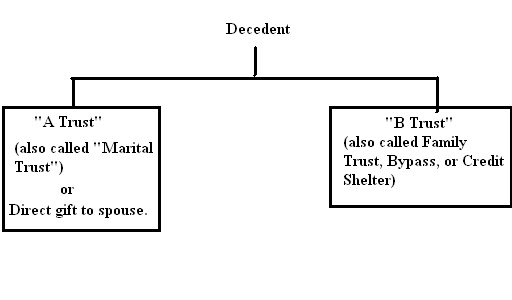
The first is traditionally called the "B Trust." In my office, we call it the "Family Trust," and other draftsmen may call it the "Credit Shelter" or "Bypass" trust. A "formula clause" in the trust instrument allocates assets to the B/Family/Credit Shelter/Bypass Trust equal to the maximum amount that can be protected from the federal estate tax by the deceased spouse's unified credit. This trust is taxable, but the tax is "paid" by the unified credit, so there's no tax due on this part.
Anything left over usually goes to what is traditionally called the "A Trust." We call it the "Marital Trust" in my office; I've also seen it called the "Marital Deduction Trust." The "A Trust" is designed to qualify for the marital deduction, so there is also no tax due on this part. The "price" of the marital deduction is that any property left in the "A" trust will be part of the spouse's gross estate at the second death.
There are a couple of variations on this arrangement that you should be aware of:
Why do we do this? There are two tax-planning reasons.
First, it ensures that we make use of the first spouse's unified credit on the first death. Up until last December, the unified credit was not transferable between individuals, so if you didn't use up the first spouse's credit when he died, it was lost forever. The 2010 tax act made unused credits "portable" between spouses, which would eliminate much of the tax reason for A-B trust arrangements--except that the 2010 tax act "sunsets" at the end of 2012, and, unless Congress amends the tax code and the President signs the amending bill into law, there will be no portability on January 1, 2013. Until we know for sure that we'll still have portability after the ball drops on New Year's Eve 2012, I am not relying on it in the estate plans I am drafting for my clients.
The second tax effect is that whatever estate taxes are paid on the couple's assets, they aren't paid until the second death. This gives the family the benefit of the time value of the money that would otherwise be paid in taxes on the first death.
Because the "A" trust has to qualify for the marital deduction, the surviving spouse is the only beneficiary while he or she is living, and the trust must pay out all of its income at least annually. The "B" trust can be anything you want. In most instances, the surviving spouse is a beneficiary, but the children or others can also be beneficiaries. The spouse's interest in the "B" trust can be more restricted than that in the "A" trust, since it need not be qualified for the marital deduction. In some situations ("blended" families in particular) the "B" component goes directly to the children or later generations on the first death, either outright or in trust.
The A-B Trust works like this: the couple divides their assets equally, and each of them creates a revocable trust to hold their share of the assets. When one of them dies, the deceased person's trust splits into two components:
The first is traditionally called the "B Trust." In my office, we call it the "Family Trust," and other draftsmen may call it the "Credit Shelter" or "Bypass" trust. A "formula clause" in the trust instrument allocates assets to the B/Family/Credit Shelter/Bypass Trust equal to the maximum amount that can be protected from the federal estate tax by the deceased spouse's unified credit. This trust is taxable, but the tax is "paid" by the unified credit, so there's no tax due on this part.
Anything left over usually goes to what is traditionally called the "A Trust." We call it the "Marital Trust" in my office; I've also seen it called the "Marital Deduction Trust." The "A Trust" is designed to qualify for the marital deduction, so there is also no tax due on this part. The "price" of the marital deduction is that any property left in the "A" trust will be part of the spouse's gross estate at the second death.
There are a couple of variations on this arrangement that you should be aware of:
- If, instead of a trust, we simply distribute the assets in the "A" component directly to the surviving spouse, the tax result is exactly the same: deduction and no tax at the first death, remaining property in the gross estate on the second death.
- If the surviving spouse is not a U.S. citizen, the "A" component will be a "qualified domestic trust."
Why do we do this? There are two tax-planning reasons.
First, it ensures that we make use of the first spouse's unified credit on the first death. Up until last December, the unified credit was not transferable between individuals, so if you didn't use up the first spouse's credit when he died, it was lost forever. The 2010 tax act made unused credits "portable" between spouses, which would eliminate much of the tax reason for A-B trust arrangements--except that the 2010 tax act "sunsets" at the end of 2012, and, unless Congress amends the tax code and the President signs the amending bill into law, there will be no portability on January 1, 2013. Until we know for sure that we'll still have portability after the ball drops on New Year's Eve 2012, I am not relying on it in the estate plans I am drafting for my clients.
The second tax effect is that whatever estate taxes are paid on the couple's assets, they aren't paid until the second death. This gives the family the benefit of the time value of the money that would otherwise be paid in taxes on the first death.
Because the "A" trust has to qualify for the marital deduction, the surviving spouse is the only beneficiary while he or she is living, and the trust must pay out all of its income at least annually. The "B" trust can be anything you want. In most instances, the surviving spouse is a beneficiary, but the children or others can also be beneficiaries. The spouse's interest in the "B" trust can be more restricted than that in the "A" trust, since it need not be qualified for the marital deduction. In some situations ("blended" families in particular) the "B" component goes directly to the children or later generations on the first death, either outright or in trust.
Wednesday, July 13, 2011
Federal Estate and Gift Taxes -- the Unified Credit, Today and Tomorrow
The federal wealth transfer taxes are imposed on any gift (with certain exceptions), and any estate, no matter how small. In order that these taxes only actually get paid by "the wealthy," everyone is given a "unified credit" against these taxes. We usually do not talk about the credit itself; rather, we refer to the "exemption equivalent," which is the amount of wealth that the credit "pays" the tax on.
When I started practicing law, and for a long time thereafter, the exemption equivalent was $600,000; that is, the credit was equal to the tax on $600,000 of lifetime gifts and/or wealth transmitted at death. Once the credit ran out, the tax rate on the 600,001st dollar was 37%, and the rate brackets topped out at 55% once you got to $3 million.
By making full use of both spouse's credits, a married couple could transmit $1.2 million to the next generation before incurring a federal tax. At the time these numbers were established, $1.2 million was a net worth that few couples could attain. After fourteen years of cumulative inflation and rising standards of living, however, the tax was starting to hit a lot of farmers, small business owners, and other upper middle class taxpayers who were rich enough, in terms of assets, to be hit by the tax, but who often weren't liquid enough to raise the cash with which to pay the tax without selling or borrowing against their main assets--the house, the farm, or the business.
The 1997 tax act.addressed this by scheduling a series of irregular increases in the unified credit that would eventually raise the exemption equivalent to $1 million. The increase was "back-loaded" so that most of it occurred in later years. By 2001, we were about halfway through the process, and the exemption equivalent was $675,000.
The 2001 tax act--which enacted what reporters, pundits, and politicians like to refer to as the "Bush tax cuts"--provided for the complete phase-out of the federal estate tax over a ten year period. The exemption equivalent for estates was increased immediately to $1 million, and scheduled to go to $1.5 million in 2004, $2 million in 2006, and $3.5 million in 2009. In 2010, the estate tax was scheduled to disappear completely. While this was going on, the top rate was decreasing from 55% to 45% in a series of irregular jumps. The exemption equivalent for lifetime gifts was capped at $1 million, and after the estate tax went out of existence there would still be a 35% tax on lifetime gifts, with a $1 million exemption equivalent.
The 2001 tax act also contained a "sunset" clause under which all the changes it worked in the tax code would be undone on January 1, 2011, which would un-repeal the estate tax and cause a return to what the 1997 tax act was working toward: an estate and gift tax with a $1 million exemption equivalent and a 55% top rate. The reason for this is because one of the rules governing the federal budget process provides that no legislation affecting revenue can be in effect for more than ten years unless it passes with at least 60 votes in the Senate. As you might remember, we had a closely-divided Senate at that time, and the 2001 tax act passed by only a small majority.
Those of us in the estate planning business expected that Congress would change things again well before 2010 so we wouldn't have that strange temporary repeal, but that didn't happen. In late 2009, there had been several bills introduced to extend the estate tax past 2009 with a $3.5 million exemption equivalent (and one that would have reduced it to $2 million!), but none of these got through the legislative process because Congress was then focused intensely on the pending "Obamacare" health care reform bill.
Consequently, there was no estate tax for nearly all of last year, but with a scheduled automatic reinstatement of the tax (and a lot of other changes to other parts of the tax code) on January 1, 2011. In December, Congress passed, and the President signed into law, legislation which prevented the sunset from taking place. For the most part, it provided that the changes to the tax code made by the 2001 tax act would continue in effect through the end of 2012--what the media, pundits, and politicians described as "an extension of the Bush tax cuts." Part of this bill reinstated the estate tax--but with a $5 million exemption equivalent, a 35% top rate, and a new "portability" provision which allows a widowed spouse to make use of any unified credit the deceased spouse did not use on his estate tax return or on lifetime gifts. This is the most taxpayer-friendly that the federal estate tax has been since 1931.
However, things may soon change for the worse. The 2010 tax act was a bundle of compromises, and one of those compromises was a provision that "sunsets" the 2010 act at the end of 2012. Unless Congress changes the tax code again before the end of next year, we will "snap back" to the 1997 version of the estate tax--an estate and gift tax with a $1 million exemption equivalent and a 55% top rate--on January 1, 2013.
There are many members of Congress who have come out in favor of making the 2010 estate tax scheme permanent. President Obama has stated on numerous occasions that he is opposed to "further extensions" of the "Bush tax cuts," which seems a pretty clear signal that he would oppose making the 2010 estate tax scheme permanent. It is probable that any legislation to address the estate tax would be introduced and debated next year--in the middle of a long and contentious national election campaign.
No one can safely predict what will happen next, and estate planning for families with small businesses and farms has gotten a lot more complicated as a result.
When I started practicing law, and for a long time thereafter, the exemption equivalent was $600,000; that is, the credit was equal to the tax on $600,000 of lifetime gifts and/or wealth transmitted at death. Once the credit ran out, the tax rate on the 600,001st dollar was 37%, and the rate brackets topped out at 55% once you got to $3 million.
By making full use of both spouse's credits, a married couple could transmit $1.2 million to the next generation before incurring a federal tax. At the time these numbers were established, $1.2 million was a net worth that few couples could attain. After fourteen years of cumulative inflation and rising standards of living, however, the tax was starting to hit a lot of farmers, small business owners, and other upper middle class taxpayers who were rich enough, in terms of assets, to be hit by the tax, but who often weren't liquid enough to raise the cash with which to pay the tax without selling or borrowing against their main assets--the house, the farm, or the business.
The 1997 tax act.addressed this by scheduling a series of irregular increases in the unified credit that would eventually raise the exemption equivalent to $1 million. The increase was "back-loaded" so that most of it occurred in later years. By 2001, we were about halfway through the process, and the exemption equivalent was $675,000.
The 2001 tax act--which enacted what reporters, pundits, and politicians like to refer to as the "Bush tax cuts"--provided for the complete phase-out of the federal estate tax over a ten year period. The exemption equivalent for estates was increased immediately to $1 million, and scheduled to go to $1.5 million in 2004, $2 million in 2006, and $3.5 million in 2009. In 2010, the estate tax was scheduled to disappear completely. While this was going on, the top rate was decreasing from 55% to 45% in a series of irregular jumps. The exemption equivalent for lifetime gifts was capped at $1 million, and after the estate tax went out of existence there would still be a 35% tax on lifetime gifts, with a $1 million exemption equivalent.
The 2001 tax act also contained a "sunset" clause under which all the changes it worked in the tax code would be undone on January 1, 2011, which would un-repeal the estate tax and cause a return to what the 1997 tax act was working toward: an estate and gift tax with a $1 million exemption equivalent and a 55% top rate. The reason for this is because one of the rules governing the federal budget process provides that no legislation affecting revenue can be in effect for more than ten years unless it passes with at least 60 votes in the Senate. As you might remember, we had a closely-divided Senate at that time, and the 2001 tax act passed by only a small majority.
Those of us in the estate planning business expected that Congress would change things again well before 2010 so we wouldn't have that strange temporary repeal, but that didn't happen. In late 2009, there had been several bills introduced to extend the estate tax past 2009 with a $3.5 million exemption equivalent (and one that would have reduced it to $2 million!), but none of these got through the legislative process because Congress was then focused intensely on the pending "Obamacare" health care reform bill.
Consequently, there was no estate tax for nearly all of last year, but with a scheduled automatic reinstatement of the tax (and a lot of other changes to other parts of the tax code) on January 1, 2011. In December, Congress passed, and the President signed into law, legislation which prevented the sunset from taking place. For the most part, it provided that the changes to the tax code made by the 2001 tax act would continue in effect through the end of 2012--what the media, pundits, and politicians described as "an extension of the Bush tax cuts." Part of this bill reinstated the estate tax--but with a $5 million exemption equivalent, a 35% top rate, and a new "portability" provision which allows a widowed spouse to make use of any unified credit the deceased spouse did not use on his estate tax return or on lifetime gifts. This is the most taxpayer-friendly that the federal estate tax has been since 1931.
However, things may soon change for the worse. The 2010 tax act was a bundle of compromises, and one of those compromises was a provision that "sunsets" the 2010 act at the end of 2012. Unless Congress changes the tax code again before the end of next year, we will "snap back" to the 1997 version of the estate tax--an estate and gift tax with a $1 million exemption equivalent and a 55% top rate--on January 1, 2013.
There are many members of Congress who have come out in favor of making the 2010 estate tax scheme permanent. President Obama has stated on numerous occasions that he is opposed to "further extensions" of the "Bush tax cuts," which seems a pretty clear signal that he would oppose making the 2010 estate tax scheme permanent. It is probable that any legislation to address the estate tax would be introduced and debated next year--in the middle of a long and contentious national election campaign.
No one can safely predict what will happen next, and estate planning for families with small businesses and farms has gotten a lot more complicated as a result.
Monday, July 11, 2011
Federal Estate and Gift Taxes -- Trusts for the Non-Citizen Spouse
As mentioned in the last installment of this series, the unlimited marital deduction is only available if your spouse is a U.S. citizen. If your spouse is not a U.S. citizen, transfers to that spouse at death will be subject to the estate tax unless you use a "qualified domestic trust," or "QDOT."
A QDOT trust must pay all of its income to the surviving spouse, and can have no other beneficiaries while the spouse is living. So far, this looks a lot like a QTIP marital deduction trust, but a QDOT is subject to additional restrictions intended to prevent the non-citizen spouse from leaving the country with the assets and thereby escaping estate taxation:
How do you prevent taxation of principal distributions? If the spouse becomes a U.S. citizen, the special QDOT restrictions and the tax on lifetime principal distributions no longer apply.
A QDOT trust must pay all of its income to the surviving spouse, and can have no other beneficiaries while the spouse is living. So far, this looks a lot like a QTIP marital deduction trust, but a QDOT is subject to additional restrictions intended to prevent the non-citizen spouse from leaving the country with the assets and thereby escaping estate taxation:
- At least one of the trustees must be an individual U.S. citizen or a U.S. trust company.
- No more than 35% of the assets of the trust may be foreign real estate.
- The U.S. trustee has the power to withhold taxes from any distribution of principal.
How do you prevent taxation of principal distributions? If the spouse becomes a U.S. citizen, the special QDOT restrictions and the tax on lifetime principal distributions no longer apply.
Friday, July 8, 2011
Federal Estate and Gift Taxes -- the Marital Deduction
A baseline policy of the federal estate and gift taxes is to tax wealth once every generation. For that reason, transfers from one spouse to another are made deductible, and therefore not taxed--subject to some important qualifications. You'll often see this referred to as the "unlimited marital deduction."
The unlimited marital deduction applies to any outright transfer to a spouse, and any transfer in trust where the assets of the trust will be included in the spouse's gross estate, and subject to tax, at the spouse's death. Before 1988, there were three trusts that qualified for the marital deduction:
The response to this was the "qualified terminable interest property" election added to the tax code in 1988, which is nicknamed "QTIP.". To qualify for the QTIP election, a trust must meet three criteria:
One last little detail: the marital deduction is only available if the spouse is a U.S. citizen. For non-citizen spouses, there is still a marital deduction of sorts, but the rules are a lot more complicated. We'll discuss that topic in our next installment.
The unlimited marital deduction applies to any outright transfer to a spouse, and any transfer in trust where the assets of the trust will be included in the spouse's gross estate, and subject to tax, at the spouse's death. Before 1988, there were three trusts that qualified for the marital deduction:
- Any trust where the spouse has a lifetime right to income and a "general power of appointment"--a right to withdraw assets from the trust, or direct them to his estate or creditors at death. Often called a "life estate plus power of appointment" trust, this was the most common arrangement.
- A trust where the spouse has a lifetime right to income and the property passes at the spouse's death to charity. (In this instance, there will be no tax on the second death because the property will qualify for a charitable deduction.)
- An "estate trust," which accumulates income while the spouse is living and pays it to her estate at death. These were used as investment vehicles back in the days when trusts paid income taxes at much lower rates than individuals. In about 20 years of private practice, I have yet to encounter one.
The response to this was the "qualified terminable interest property" election added to the tax code in 1988, which is nicknamed "QTIP.". To qualify for the QTIP election, a trust must meet three criteria:
- The spouse must receive all of the income of the trust while living.
- The trust may not have any other beneficiary while the spouse is living.
- The estate must make a "QTIP election" on the estate tax return.
One last little detail: the marital deduction is only available if the spouse is a U.S. citizen. For non-citizen spouses, there is still a marital deduction of sorts, but the rules are a lot more complicated. We'll discuss that topic in our next installment.
Wednesday, July 6, 2011
Federal Estate and Gift Taxes -- the Gross Estate
The federal estate tax is a tax imposed on the "privilege" of transferring property at death. Because it's imposed on transfers of property, it taxes more than just the property in your probate estate. The "gross estate," as we call it, consists of the probate estate, plus all sorts of arrangements that are intended to avoid probate, such as:
- Joint and survivorship assets.
- Payable-on-death and transfer-on-death assets.
- A revocable trust.
- Any irrevocable trust you've created, if you retain control over the disposition of wealth at your death--what we sometimes call a "taxable string" power--either as trustee or by some other means.
- Retirement accounts and annuities with a death benefit or survivor benefit.
- Assets which you have technically given away, but retain the right to use during lifetime. The classic example of this is a life estate in real property.
- Assets whose disposition you control through a power of appointment, but only if that power lets you appoint the assets to yourself, your estate, or your creditors. Powers of appointment have a lot of uses in sophisticated estate planning, and we'll go into detail about how they work in a future post.
Wednesday, June 22, 2011
Federal Estate and Gift Taxes - an Introduction
The federal estate and gift taxes--we sometimes call them "wealth transfer taxes"--are the reason for much of what I do for my higher net-worth clients. These taxes have gotten a lot of attention and debate time among pundits and politicians recently, and we're going to be talking about them a lot on this blog. This post is the first in a series on how these taxes work, and what you can do to minimize their impact on your family.
The stated policy purpose of the wealth transfer taxes is to prevent the creation of large concentrations of inherited private wealth. The tax is therefore supposed to be paid only by "the wealthy." There's a never-ending debate over whether this is a proper thing for the government to be taxing in the first place, and whether it's not so much a tax on dynastic wealth as it is a tax on upward mobility--but all I want to talk about on this blog is how the taxes work, and how good estate planning responds to them.
While the estate tax is imposed on any transfer at death, and the gift tax on any transfer during lifetime, the Internal Revenue Code gives you a "unified credit" which cancels out the tax on a certain amount of wealth being transferred. We usually talk about the "exemption equivalent" amount that is protected from the credit, rather than the amount of the credit, because it's easier for clients to understand. However you want to think of it, if the wealth that you have to pass on to the next generation is less than the exemption equivalent, the federal wealth transfer taxes aren't an issue you need to worry about. (The Ohio estate tax might be, butthat's another topic for another time only if you die before January 1, 2013.)
Right now, the exemption equivalent is $5 million, but that could change in a very taxpayer-unfavorable way at the end of next year. We'll go into why that is in a future installment.
There are a couple of other mechanisms that provide relief from the estate and gift taxes. The policy of the current estate tax is to tax accumulated wealth once per generation, so transfers between spouses are accorded a "marital deduction" and are thereby not taxed. Also, mostly for administrative convenience, you are allowed a certain amount of gifts each year, the "annual exclusion," which are not counted for tax purposes. The annual exclusion is $13,000 per recipient per year, and that number is adjusted for inflation from time to time.
In our next installment, we'll talk about what gets included in an estate for estate tax purposes.
(Updated in response to the repeal of the Ohio estate tax effective 1/1/13.)
The stated policy purpose of the wealth transfer taxes is to prevent the creation of large concentrations of inherited private wealth. The tax is therefore supposed to be paid only by "the wealthy." There's a never-ending debate over whether this is a proper thing for the government to be taxing in the first place, and whether it's not so much a tax on dynastic wealth as it is a tax on upward mobility--but all I want to talk about on this blog is how the taxes work, and how good estate planning responds to them.
While the estate tax is imposed on any transfer at death, and the gift tax on any transfer during lifetime, the Internal Revenue Code gives you a "unified credit" which cancels out the tax on a certain amount of wealth being transferred. We usually talk about the "exemption equivalent" amount that is protected from the credit, rather than the amount of the credit, because it's easier for clients to understand. However you want to think of it, if the wealth that you have to pass on to the next generation is less than the exemption equivalent, the federal wealth transfer taxes aren't an issue you need to worry about. (The Ohio estate tax might be, but
Right now, the exemption equivalent is $5 million, but that could change in a very taxpayer-unfavorable way at the end of next year. We'll go into why that is in a future installment.
There are a couple of other mechanisms that provide relief from the estate and gift taxes. The policy of the current estate tax is to tax accumulated wealth once per generation, so transfers between spouses are accorded a "marital deduction" and are thereby not taxed. Also, mostly for administrative convenience, you are allowed a certain amount of gifts each year, the "annual exclusion," which are not counted for tax purposes. The annual exclusion is $13,000 per recipient per year, and that number is adjusted for inflation from time to time.
In our next installment, we'll talk about what gets included in an estate for estate tax purposes.
(Updated in response to the repeal of the Ohio estate tax effective 1/1/13.)
Subscribe to:
Posts (Atom)